No items found.
Our Products

Product Carbon Footprint

Get product-level environmental insights. Respond to PCF requests, report progress, improve your products

You need PCFs faster than you can calculate them

Your customers request PCF data on hundreds of products for Scope 3 reporting and supplier evaluations.

At the same time, R&D want to optimise products during development, Procurement wants to optimise sourcing and marketing wants to share your sustainability progress. Manual processes can't meet the PCF demand.

Without a Product Foorprinting Solution

You can’t calculate product footprints at the scale and speed needed
PCFs are inconsistent with your corporate data
Generic measurements hide sourcing improvements
No data to support green claims
Your sales teams can’t show carbon credentials

With a Product Footprinting Solution

Respond to customer PCF requests in days and never lose a contract over slow data
Design lower-carbon products
Justify premium pricing with verified product-level data
Capture sustainability-conscious buyers with credible carbon claims
B2B PCF RESPONSE

Respond to customer PCF requests in days

Calculate PCFs at any scale, whether it's 5 priority products or 500 SKUs simultaneously.

Upload data without LCA expertise
Upload ingredient data as you have it - no LCA expertise needed. Automated mapping handles the complexity, so you get product footprints without needing specialists.
Export in any format customers needs
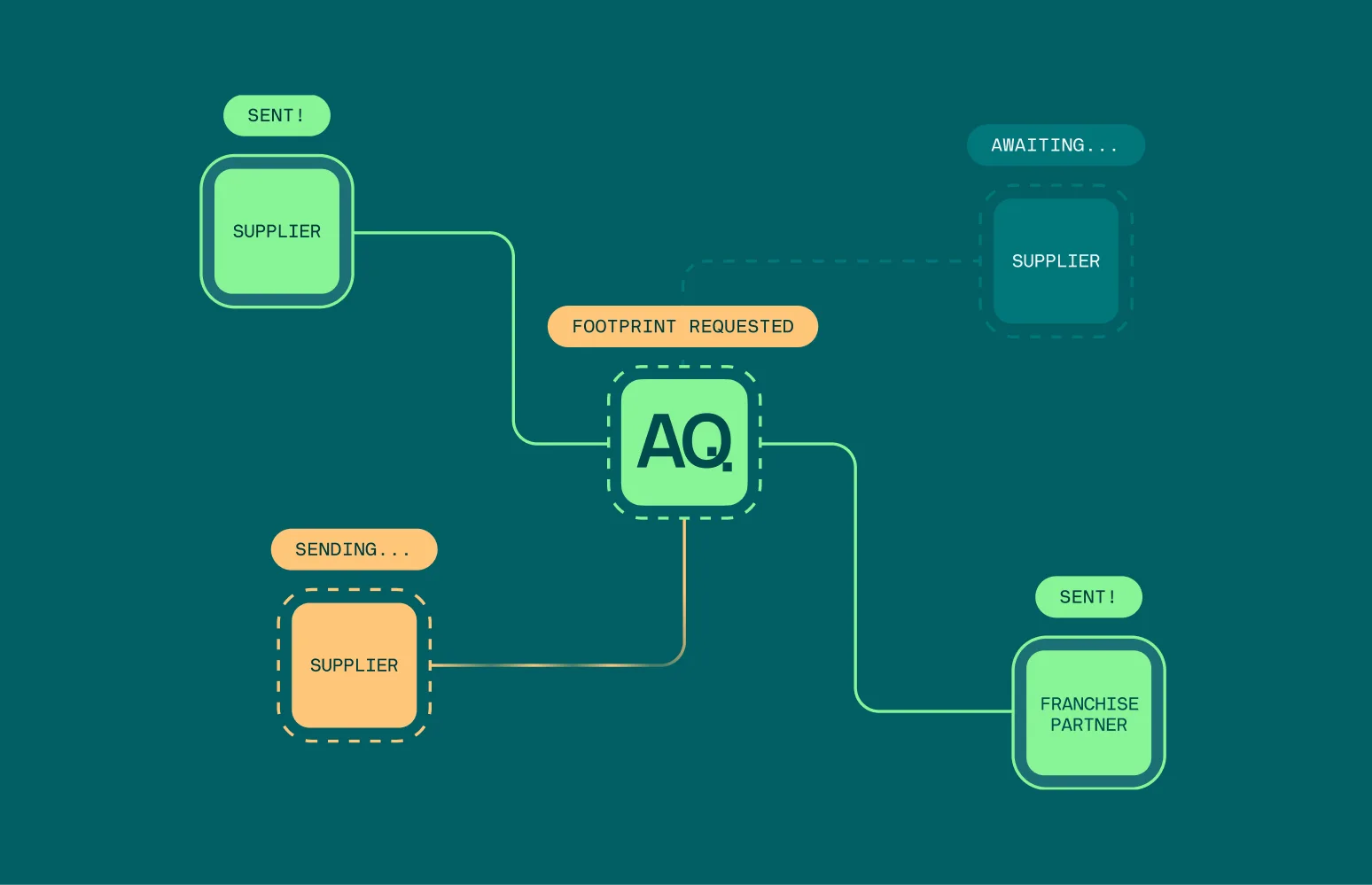
From PDF reports, data files, to PACT-conformant exchange. Meet the requirements of all your customers, retailers, brands and more – without recreating calculations each time.
Equip sales teams with customer-ready data
Pre-built dashboards show carbon performance in visual, sales-friendly formats. Export PCFs for tender responses and customer negotiations. 
Product Carbon Footprints in Altruistiq
Product Eco-Design

Optimise formulations and identify hotspots, dependencies, and risks

Identify which products, ingredients, or suppliers drive emissions. Model ingredient swaps and packaging alternatives. Track improvements over time and prove ROI from sustainable sourcing.
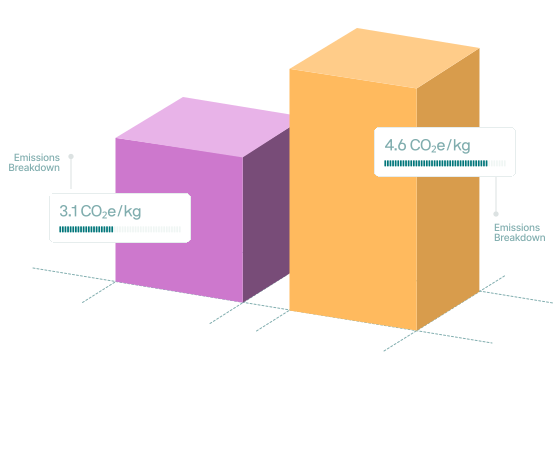
Model formulations before launch
R&D sees carbon impact during formulation, modelling ingredient swaps and packaging alternatives before launch. Environmental data becomes part of product decisions.
Build business cases with real numbers
Demonstrate how sustainable products deliver environmental and economic value. Justify premium pricing from low-carbon claims or cost savings from efficient suppliers.
Track improvements as they happen
Monitor how product footprints change as you transition to regenerative suppliers or optimise recipes. Prove improvements with data showing actual progress.
Model lower carbon products
On Pack Sustainability claims

Launch with credible carbon claims & labels

Build carbon labels with audit-ready data that withstands scrutiny from regulators and customers.


Extend to complete lifecycle when needed
Build cradle-to-grave footprints (including distribution, consumer use, and end-of-life) for carbon labels that require comprehensive impact.
Document every calculation
Trace every number from ingredients through manufacturing with version control to show what changed between label updates. Maintain defensibility as formulations evolve and claims get challenged.
Prove ROI from sustainable operations
Demonstrate how low-carbon products perform commercially. Link carbon labels market share or premium pricing success.

Trusted by enterprises managing sustainability at scale

98m+
tCO2e measured across global food & beverage operations.
800+
businesses exchanging supplier data through PACT network.
400,000+
product footprints calculated with ingredient-level precision
10x
faster response in days instead of months for customer PCF requests

What makes the

approach different?

Built for B2B scale
We’re built to handle messy enterprise data. You can process thousands of product calculations and respond to hundreds of customer requests in days. Our automated recalculations also keep PCFs up to date when ingredients or suppliers change. 
Credible, standards-aligned calculations
Our calculations are PACT and PEF aligned. We’re also PACT Technical Advisors leading the Agri-Food Extension development alongside Oxford and Imperial scientific advisors. So you can share airtight PCFs.
Consistent with your Corporate Baseline
Product PCFs use the same processing data, emissions factor database, and supplier-specific data as your corporate Scope 1, 2, and 3 calculations. When customers or auditors compare your product data to corporate reports, the numbers match.
case studies

Why leading food & beverage enterprises choose AQ

"We've been able to build out our decarbonisation plan, set a carbon intensity target and kick off key initiatives within the product categories."
63%
Statistic label
1.8x
Statistic label
900k+
Statistic label
Emma Detain
Sustainability Manager @ Huel
Read the full story
Woman with auburn hair wearing a blue striped shirt and white skirt sitting on a light gray couch in a warmly lit modern room.
“There’s been so much joy for me in being able to visually tell a story through the data. I think for me it’s about being able to communicate impact in a way that anyone can understand.”
63%
Statistic label
1.8x
Statistic label
900k+
Statistic label
Elliot Baird
Impact Analyst @ GrowUp Farms
Read the full story
“Having better quality data and being more accurate in our analysis allows us to support better decision making. Altruistiq has really enabled that.”
63%
Statistic label
1.8x
Statistic label
900k+
Statistic label
David Spitzley
Director of Impact Measurement @ Starbucks
Learn more
Man in black shirt gesturing while speaking in front of a bookshelf with books and plants.
“Having better quality data and being more accurate in our analysis allows us to support better decision making. Altruistiq has really enabled that.”
63%
Statistic label
1.8x
Statistic label
900k+
Statistic label
Toby Booth
Impact Measurement Lead @ Starbucks
Read the full story
"It's going to be a tremendous help. It's part of the demands we're receiving from most of our clients."
63%
Statistic label
1.8x
Statistic label
900k+
Statistic label
Renato Rodríguez
Technical Manager & Group Sustainability Lead @ Sugal Group
Read the full story
“Having better quality data and being more accurate in our analysis allows us to support better decision making. Altruistiq has really enabled that.”
63%
Statistic label
1.8x
Statistic label
900k+
Statistic label
Alun Lewis
Head of Sustainability @ Meadow Foods
Read the full story
"We can now see the footprint of a bottle of ketchup, broken down into its components. It's completely new information that used to take months to collect. That is just transformative."
63%
Statistic label
1.8x
Statistic label
900k+
Statistic label
Steff Kulis
Head of ESG Digital Transformation @ Kraft Heinz
Read the full story
Side profile of a woman with long red hair and glasses wearing a navy blue floral top, standing indoors near shelves with a globe and scales.
“We're seeing analysis like we've never seen before with the Altruistiq platform. I can actually see the bottle of ketchup and the impact broken down into components. It's completely new information that used to take months to collect.”
63%
Statistic label
1.8x
Statistic label
900k+
Statistic label
Vita Jarolimkova
Head of Sustainability @ Stuart
Read the full story
How it works

One platform for product development, customer response, and market launch

Connect product data

Step 1

AI-powered mapping connects your PLM systems, recipe databases, and procurement platforms without requiring code. Map your systems directly in-app, or push data from existing tools – working with the infrastructure you already have.

Calculate PCFs

Step 2

Choose your starting point: one product category, line, or location. Follow step-by-step checklists guiding you through data collection and calculation. Data validation guardrails catch errors before they affect results.

Model Eco-Design

Step 3

R&D teams see carbon impact during formulation, letting them model ingredient swaps and compare packaging alternatives before launch. This puts environmental data directly where product decisions happen rather than making sustainability an afterthought.

Respond to customer requests

Step 4

When a customer requests PCF data on 200 products, generate calculations in days and export in their required format. Respond at a speed that protect contracts, rather than watching business go to faster competitors.

Launch with claims

Step 5

Marketing wants carbon labels and legal needs defensible data – you provide audit-ready calculations with full traceability. Launch with claims that can withstand scrutiny from customers or regulators.
Pricing

Start where you are. Add capabilities as you grow

Get started with product footprinting to respond to urgent customer requests. Add corporate baseline when compliance becomes priority. Expand to supply chain engagement when ready for supplier programmes.
Pay per module. Scale investment with programme maturity.
Talk to sales about pricing

Turn product data into commercial advantage

One platform delivers PCF data for B2B customers, consumer marketing, R&D optimisation, procurement decisions, and sales conversations – creating one source of truth across teams.

Related Solutions

Corporate Carbon Footprint

Establish audit-ready baseline that aligns with product calculations. Meet CSRD, CDP, and regulatory requirements with unified methodology.
Learn more

Supply Chain Decarbonisation

Engage suppliers at scale to reduce Scope 3. Join 800+ businesses exchanging PACT-conformant data.
Learn more

FAQs

How long does PCF calculation take?

Days for bulk portfolios. Hours for individual products. 10x faster than traditional LCA.

Bulk processing calculates hundreds of products in days. Individual product optimisation during development takes hours. Automated recalculations flow through when ingredients change, without manual rework.

How much does this cost, and can we start with just a few products?

Yes – modular pricing means start small, scale as needs grow.

Business Units let you start with one product category or one customer (10 PCFs for your biggest customer, prove value, then expand portfolio-wide). Pay only for what you need. No need to calculate everything before sharing anything.

Can you handle recipe variations across regions?

Yes – model ingredient variations, regional sourcing differences, and seasonal changes at SKU-level precision.

Calculate distinct footprints for regional recipe variations, seasonal ingredient availability, and local sourcing differences. Handle product complexity at granular level.

How is this different from traditional LCA or using consultants?

Traditional LCA: Tackles products individually over months using static studies. Results outdated by delivery.

Consultant approach: Expensive one-off spend. Black box calculations you can't understand or defend. Knowledge loss when consultant leaves.

Altruistiq: Calculate hundreds simultaneously in days with automated updates when formulations change. Unified with corporate footprint (not isolated assessments). Transparent methodology you can defend to customers and auditors.

What customer formats do you support?

PDF reports, data exports, PACT-conformant exchange, custom formats – meet any retailer requirement.

Export in any format customers need from single calculation.

Can R&D use this during development, or is it too complex?

Yes. Altruistiq is designed for product teams too, not just sustainability experts. Integrate into PLM systems where R&D already works.

Model ingredient swaps and packaging alternatives before committing to formulations. Environmental data becomes part of product decisions in existing workflows.

Guided checklists walk you through step-by-step whether you're LCA expert or complete beginner. Round-the-clock support from sustainability advisors (average response <45 minutes).

How accurate is bulk calculation compared to detailed LCA?

Same ISO14064-1 assured methodology as detailed LCA. 200K+ environmental factors provide ingredient-level precision.

Bulk processing doesn't sacrifice accuracy, it uses the same assured methodology with supplier-specific data and ingredient-level factors.

How does this integrate with our systems (PLM, procurement, ERP)?

Connect customised PLM systems, recipe databases, procurement platforms. Push data from enterprise data lakes and existing product management tools. SSO ready for enterprise access controls.

What if our data is messy or incomplete?

Upload ingredient data as you have it (spreadsheets, recipes, procurement files). Automated intelligence handles cleaning and preparation. Data quality ratings show you how to improve over time.